
Study offers clues to blood cancer risk, revealing how gene mutations compete over time
Researchers at Barts Cancer Institute, Queen Mary University of London, have developed a new way to understand how genetic changes linked to blood cancer evolve in our cells and why most people who carry these mutations never develop disease.
The new findings, published today in Cancer Discovery, could support the development of new ways to assess a person’s risk of blood cancer and support early diagnosis and treatment.
As we age, the stem cells from which we derive all our blood cells gradually accumulate mutations in their DNA, some of which are associated with blood cancers such as leukaemia. However, only a small proportion of people who carry these cancer-associated mutations go on to develop the disease.
“The question is, why does cancer develop only in a minority of people with these mutations?” asks Dr Benjamin Werner, senior author of the new study and group leader at Barts Cancer Institute. “What is the difference between the people who do and do not develop cancer, and how can we predict who is at risk?”
This question is becoming increasingly important as genomic sequencing becomes more widely used in healthcare, raising challenges about how to interpret these findings and when to intervene.
Looking beyond individual mutations
To investigate this, the team analysed multiple publicly available sequencing data showing how mutation propensities change in blood stem cells through life. Dr Nathaniel Mon Pere, a Postdoctoral Researcher in Dr Werner’s lab, realised that some previously puzzling ways that mutations change as we age could be explained by considering how different mutations present in different stem cells compete with each other.
“I was on an aeroplane reading one of these previous studies, and I suddenly realised I could explain the patterns”, Dr Mon Pere recalls. “I started mapping out some ideas with pen and paper and then shared my ideas with Ben.”
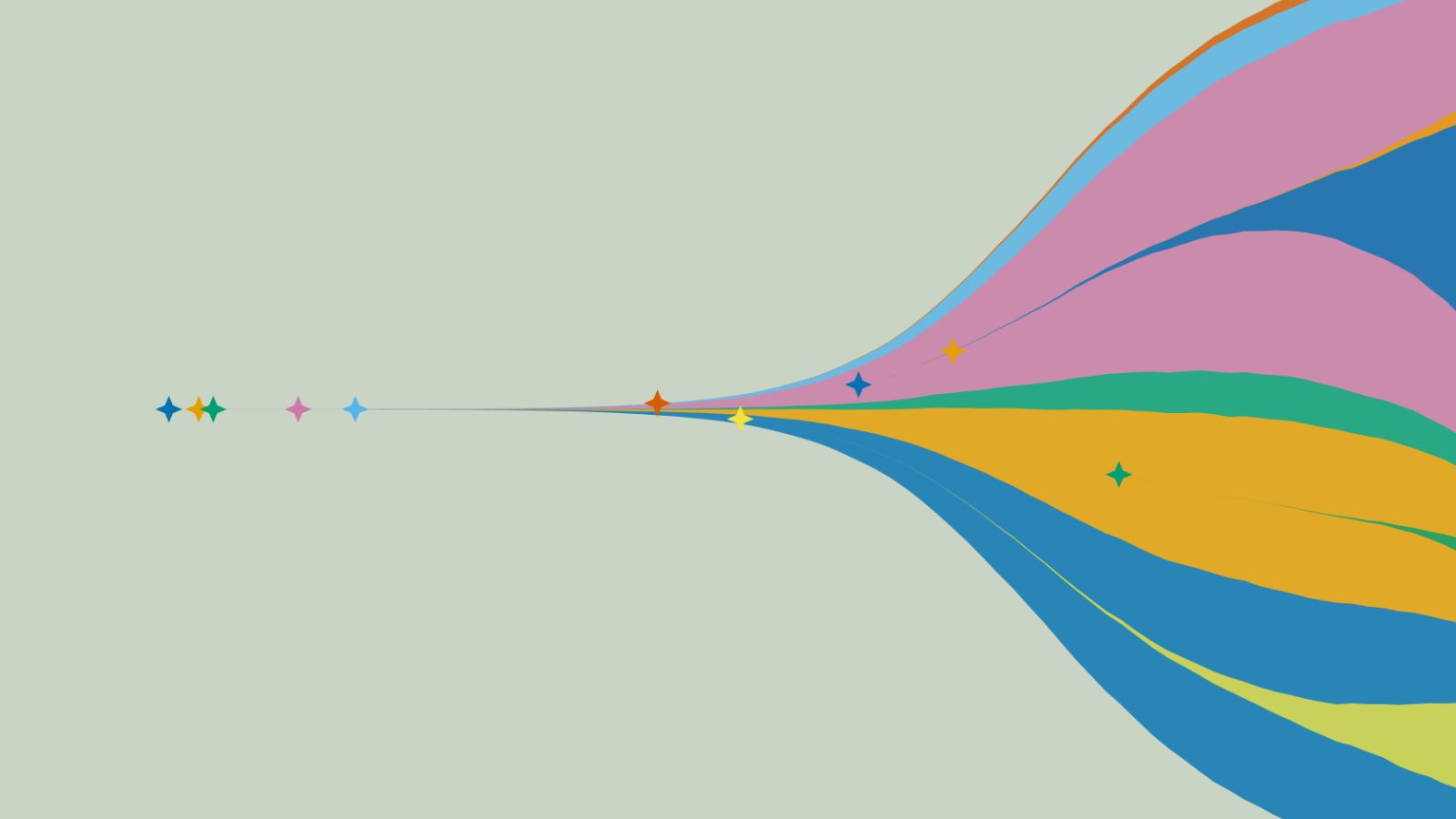
The researchers found that mutations do not act in isolation. Instead, a mosaic of mutated stem cells emerges over time, and populations of cells compete with one another. This means that the same mutation may behave differently between different people and different ages, as the mosaic patterns of stem cell mutations are unique for each person and become denser as we age, creating a more crowded and competitive environment.
The team developed a mathematical model based on these principles and showed that it accurately reproduces the genetic diversity in human blood stem cells, predicting how the landscape of different mutations changes from early life through to old age.
Rather than a small number of selected mutations steadily increasing over time, as had previously been assumed, the model predicts that in the order of hundreds of mutations under selection are present in human blood stem cells by the age of 50. However, typically only a small fraction is detectable due to the current limited resolution of genetic sequencing.
Implications for risk and early detection
Importantly, the findings suggest it is possible to predict what changes in the mosaic patterns of stem cell genetic diversity are expected in normal ageing, and which could be warning signs of early cancer. In future, this could help identify individuals who may benefit from closer monitoring and possibly treatment. The researchers are now working to develop risk prediction tools based on their model that could support this kind of assessment.
While further work is needed, the research provides a new quantitative framework for understanding how cancer-associated mutations evolve, and how we might interpret them in a clinical context.
This study was made possible thanks to funding from UKRI and Barts Charity.
Category: General News, Publications
No comments yet