
Latest News
Search News

Discovery reveals new understanding of cancer-driving proteins in rare brain tumours and beyond
7th November 2025
Scientists have discovered that a single letter change in a gene called PRKCA drives a rare and hard-to-treat brain cancer, chordoid glioma, through an entirely unexpected mechanism. The findings could open up new ways to design targeted treatments for this difficult-to-treat disease, and possibly for other cancers involving the same gene.
Read more
New spinout launches to advance early pancreatic cancer detection
29th October 2025
Queen Mary University of London has launched a new company, Procyon Diagnostics, to provide pioneering early cancer detection tests. The company’s first test, PancRISK, offers new hope for detecting pancreatic cancer earlier, building on over 15 years of research by Professor Tatjana Crnogorac-Jurcevic at Queen Mary’s Barts Cancer Institute (BCI), funded by the Pancreatic Cancer Research Fund.
Read more
Blood test helps guide immunotherapy for bladder cancer
22nd October 2025
A new clinical trial led by Professor Thomas Powles at Barts Cancer Institute, Queen Mary University of London, has shown that a blood test to detect tumour DNA could help doctors decide which patients with bladder cancer are most likely to benefit from further treatment after surgery. The new approach improved survival in those identified as high-risk while safely sparing low-risk patients from unnecessary side effects.
Read more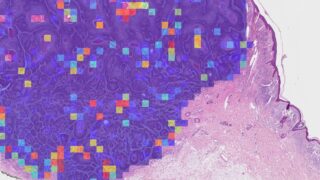
New AI model sheds light on high-risk skin cancer: Q&A with the authors
30th September 2025
Researchers have developed an artificial intelligence (AI) tool that could help doctors identify which skin cancers are most likely to spread. We spoke to Professor Jun (Alex) Wang, a group leader at BCI, and Dr Emilia Peleva, a Clinical Research Fellow and dermatologist in his team, about their new study, published in npj Precision Oncology.
Read more
Rogue’ DNA rings reveal earliest clues to deadly brain cancer’s growth
8th September 2025
An international team of scientists has revealed how rogue rings of DNA that float outside of our chromosomes – known as extrachromosomal DNA, or ecDNA – can drive the growth of a large proportion of glioblastomas, the most common and aggressive adult brain cancer. The discovery could open the door to much-needed new approaches to diagnose glioblastoma early, track its progress and treat it more effectively.
Read more
Breakthrough life-extending treatment for advanced bladder cancer available on NHS
21st August 2025
The new combination treatment offers hope to thousands of people living with advanced urothelial cancer. The clinical trials, led by Professor Tom Powles at Barts Cancer Institute, Queen Mary University of London, showed that overall survival rates were almost twice as long with this new treatment compared to the current standard treatment.
Read more