
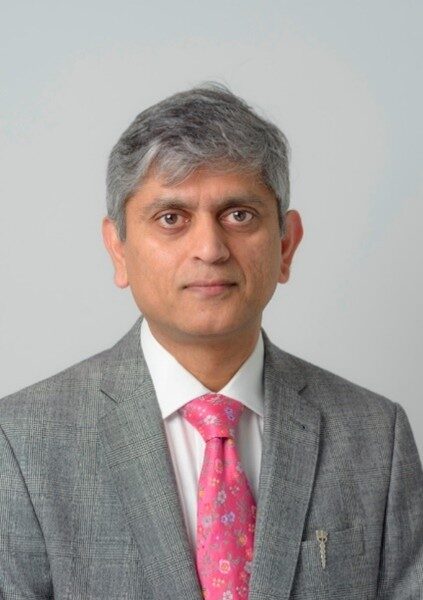
Professor Bijendra Patel
MBBS, MS
Professor of Surgery (Laparoscopy and Surgery Skills)
Consultant Upper GI & Laparoscopic Surgeon
Director of Laparoscopic & Robotic Surgery and Surgical Skills
Royal College of Surgeons, Edinburgh
Teaching Focus
I am a leading expert in establishing higher education degrees for acquiring operative surgical skills by simulation. I pioneered the Masters course in Surgical Skills and Sciences at Barts Cancer Institute, Queen Mary University of London and have set up a “Virtual Reality Surgical Simulation Centre” for training surgeons.
Key Publications
Hereditary diffuse gastric cancer: updated consensus guidelines for clinical management and directions for future research. J Med Genet (2010) 47: 436-444. PMID: 20591882
Emergency Room surgical workload in an inner city UK teaching hospital. World Journal of Emergency Surgery (2008) 3:19. PMID: 18513422
Procedural Performance in Gastrointestinal Endoscopy: An Assessment & Self-Appraisal Tool. American Journal of Surgery (2008) 196(3):450-5. PMID: 18585680
Simulation and surgical training. International Journal of Clinical Practice (2007) 61(12):2120-5. PMID: 17949430
Other Activities
- Laparoscopy surgery tutor at the Royal College of Surgeons of England
Themes/Keywords
Other Activities
- Laparoscopy surgery tutor at the Royal College of Surgeons of England
Recent Publications
Perioperative outcomes between laparoscopic versus open versus robotic partial nephrectomy: Current Review. Wong R, Patel B, Biyani CS Urologia Journal (2023) (10) 3915603231211975
Systematic review and meta-analysis of cost-effectiveness of minimally invasive versus open pancreatic resections Lee S, Varghese C, Fung M et al. Langenbeck's Archives of Surgery (2023) 408(10) 306
Accuracy of diagnostic tests in cardiac injury after blunt chest trauma: a systematic review and meta-analysis Kyriazidis IP, Jakob DA, Vargas JAH et al. World Journal of Emergency Surgery 18(10) 36
Robotic versus open pancreaticoduodenectomy, comparing therapeutic indexes; a systematic review Mantzavinou A, Uppara M, Chan J et al. International Journal of Surgery (2022) 101(10) 106633
The effect of verbal feedback, video feedback, and self-assessment on laparoscopic intracorporeal suturing skills in novices: a randomized trial Halim J, Jelley J, Zhang N et al. Surgical Endoscopy (2021) 35(10) 3787-3795
Design of a Proficiency-Based Skills Training Curriculum for Our Newly Validated 3-Dimensional (3D) Laparoscopic Models, Using MISTELS Merali N, Iosif E, Morawala AJ et al. Journal of Investigative Surgery (2021) 34(10) 194-204
Acquiring basic and advanced laparoscopic skills in novices using two-dimensional (2D), three-dimensional (3D) and ultra-high definition (4K) vision systems: A randomized control study Abdelrahman M, Belramman A, Salem R et al. International Journal of Surgery (2018) 53(10) 333-338
Femorofemoral Crossover Bypass Graft Has Excellent Patency When Performed with EVAR for AAA with UIOD Akingboye AA, Patel B, Cross FW Southern Medical Journal (2018) 111(10) 56-63
Unplanned medical visit and readmission within 30 days following day case surgery Eltweri AM, Islam S, Patel B BRITISH JOURNAL OF SURGERY (2015) 102(11) 27-28
https://www.webofscience.com/api/gateway?GWVersion=2&SrcApp=PARTNER_APP&SrcAuth=LinksAMR&KeyUT=WOS:000354029300085&DestLinkType=FullRecord&DestApp=ALL_WOS&UsrCustomerID=612ae0d773dcbdba3046f6df545e9f6a
The effect of varying doses of caffeine on laparoscopic skill performance in novices Quan V, Elbakbak W, Gavrila A et al. BRITISH JOURNAL OF SURGERY (2014) 101(11) 34-34
https://www.webofscience.com/api/gateway?GWVersion=2&SrcApp=PARTNER_APP&SrcAuth=LinksAMR&KeyUT=WOS:000334502500108&DestLinkType=FullRecord&DestApp=ALL_WOS&UsrCustomerID=612ae0d773dcbdba3046f6df545e9f6a
Biography
Prof B Patel is Professor of Surgery & Director of Laparoscopic & Robotic Surgery and Surgical Skills at Queen Mary University of London and at Barts Health NHS Trust London, UK. He is an internationally recognised leader in the field of technology-enhanced surgical education. In October 2005, he created the world’s first master’s course in acquiring surgical skills by virtual reality simulation to fast-track surgical training. As Programme Director of the MSc in Laparoscopic and Robotic Surgery and Surgical Skills at Queen Mary University of London, he has played a pivotal role in transforming how technical skills are taught, assessed, and scaled within modern surgical curricula. His work bridges clinical expertise with educational research and simulation technology, enabling a data-driven, personalised, and scalable model of surgical training.
With a career spanning over two decades, Prof. Patel has pioneered the integration of virtual reality (VR), augmented reality (AR), and mixed reality (MR) into hands-on surgical training, alongside implementation of Non-Technical Skills for Surgeons (NOTSS).
Prof. Patel’s approach challenges the traditional Halstedian "see one, do one, teach one" paradigm by advocating for evidence-based, simulation-led, and AI-supported frameworks. He has developed competency-based programmes that support surgeons at all levels, from novice to expert, and promotes equitable access to high-quality surgical training, particularly in low- and middle-income countries.
He has published widely, contributed to policy discussions on surgical education reform, and serves as an advisor to simulation companies and academic institutions on curriculum design and implementation. He has presented internationally at forums such as ALSGBI, EAES, ASiT, ASICON, COSECSA, MSE, and the Society of Surgical Simulation and Innovation (SSSI).
My main academic interests are in:
- Surgical education in acquiring operative skills by simulation
- Developing curriculum for acquiring surgical skills by simulation
My main clinical interests are in:
- Surgery for benign and malignant diseases of the oesophagus and stomach
- Laparoscopic and bariatric surgery
- SILS - Single Incision Surgery
- General and gastrointestinal surgery
Profile
I joined the Queen Mary College and Barts and The London NHS Trust in August 2004 as a Clinical Senior Lecturer in Upper Gastrointestinal Surgery. I graduated from University of Bombay, India, in 1992 and have obtained the higher specialist training in Laparoscopic and Upper Gastrointestinal Surgery in the UK from 1994 to 2004. I am a fellow of the Royal College of Surgeons of Edinburgh.
In my current consultant post at Barts and the Royal London Hospital, I provide the regional gastro-oesophageal cancer service for Inner East London.
I am also the Course Director for the Masters (MSc) in Laparoscopic Surgery & Surgical Skills at Barts Cancer Institute, Queen Mary University of London. As a director I am involved in the delivery, quality assurance, and quality enhancement of this course.