
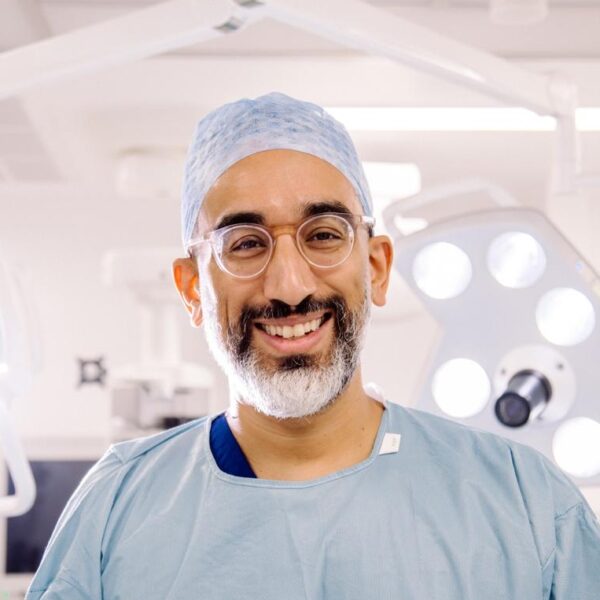
Professor Prabhakar Rajan
PhD, FRCS (Urol), FHEA
Professor Urology and Robotic Surgery
Group Leader
Research Focus
My research programme spans basic biology, translational research, clinical trials, and population health. In the laboratory, we are exploring how a fundamental genetic process called alternative splicing reshuffles genes to create new proteins that underpin prostate cancer initiation and progression. Clinically, we are investigating ways to reduce the side effects of current treatments for advanced testicular and early prostate cancers. On a population level, we are studying how healthcare disparities in cancer outcomes for different ethnic groups, and how cancer risk can be mitigated for these populations.
Key Publications
Sociodemographic landscape of suspected prostate cancer referrals and diagnoses across North East London. BJUI Compass (2025) Feb 4;6(2):e495. PMID: 39917583
Treatment de-escalation for stage II seminoma. Nat Rev Urol. (2023) Aug;20(8):502-51 PMID: 36882564
FOXA1 regulates alternative splicing in prostate cancer. Cell Rep (2022) 40(13):111404. PMID: 36170835
Feasibility of aspirin and/or vitamin D3 for men with prostate cancer on active surveillance with Prolaris® testing. BJUI Compas (2022) Jun 11;3(6):458-465. PMID: 36267207
The effect of comorbidity on prostate cancer-specific mortality: A prospective observational study. J Clin Oncol (2017) 35(31):3566-3574. PMID: 28930493
Major Funding
- 2024-2027 – NIHR/Health Education England Academic Clinical Fellowship, ‘Novel biomarker discovery approaches to immunotherapies,’ ~£200,000 (Role: PI)
- 2023-2026 – Prostate Cancer UK Research Innovation Award, “Understanding and exploiting the PTEN driven alternative splicing programme in hypoxic prostate tumours” ~£275,357 (Role: PI)
- 2023-2026 – NIHR/Health Education England Academic Clinical Fellowship, ‘Machine learning-led prostate cancer liquid biopsy biomarker panel discovery,’ ~£200,000 (Role: PI)
- 2021-2027 – Barts Charity Large Project Grant, THERATEST (THERApy de-escalation in TESTicular cancer), £143,000 (Role: PI)
- 2021-2024 – MRC DTP in Translational Immunology, Inflammation and Cancer, ‘Identification of splicing-driven putative neoantigens using proteomics informed by transcriptomics’, £80,000 (Role: PI)
Other Activities
- 2023 to date – Research Advisory Committee Member, Prostate Cancer UK
- 2021 to date – Deputy Programme Director, MSc in Laparoscopic Surgery & Surgical Skills, Barts Cancer Institute
- 2021 to date – Module Lead, CAN7028 Laparoscopic Skills, Barts Cancer Institute
- 2021 to date – Module Lead, CAN7026 Laparoscopic Skills Suturing Skills, Barts Cancer Institute
- 2019 to date – University College London Urology Clinical Academic Board
Research
Our laboratory-based research explores how alternative pre-mRNA splicing, a ubiquitous post-transcriptional gene regulatory mechanism, underpins prostate cancer (PCa) phenotypes. During alternative splicing, coding (exons) and non-coding (introns) regions of a single gene are shuffled to create different protein isoforms with different functions. Alternative splicing is regulated by trans-acting RNA-binding proteins (RBPs), is tightly coupled to transcriptional programmes, and responsive to intracellular signalling cascades.
Many early prostate tumours can be managed by active surveillance, which aims to delay or defer treatment, thereby avoiding or deferring the treatment-related side effects. We are investigating ways to increase the adoption of active surveillance using strategies to reduce disease progression or “drop out” from surveillance programmes. We are also exploring new ways to manage advanced testicular cancers by employing minimally-invasive surgery to reduce or avoid chemotherapy-related side effects.
We are studying healthcare disparities in cancer risk and outcomes. We are interested in the genetic determinants of prostate cancer risk amongst South Asians, and improving prostate cancer outcomes in the Black community through participatory action research.
Other Activities
- 2023 to date – Research Advisory Committee Member, Prostate Cancer UK
- 2021 to date – Deputy Programme Director, MSc in Laparoscopic Surgery & Surgical Skills, Barts Cancer Institute
- 2021 to date – Module Lead, CAN7028 Laparoscopic Skills, Barts Cancer Institute
- 2021 to date – Module Lead, CAN7026 Laparoscopic Skills Suturing Skills, Barts Cancer Institute
- 2019 to date – University College London Urology Clinical Academic Board
Major Funding
- 2024-2027 – NIHR/Health Education England Academic Clinical Fellowship, ‘Novel biomarker discovery approaches to immunotherapies,’ ~£200,000 (Role: PI)
- 2023-2026 – Prostate Cancer UK Research Innovation Award, “Understanding and exploiting the PTEN driven alternative splicing programme in hypoxic prostate tumours” ~£275,357 (Role: PI)
- 2023-2026 – NIHR/Health Education England Academic Clinical Fellowship, ‘Machine learning-led prostate cancer liquid biopsy biomarker panel discovery,’ ~£200,000 (Role: PI)
- 2021-2027 – Barts Charity Large Project Grant, THERATEST (THERApy de-escalation in TESTicular cancer), £143,000 (Role: PI)
- 2021-2024 – MRC DTP in Translational Immunology, Inflammation and Cancer, ‘Identification of splicing-driven putative neoantigens using proteomics informed by transcriptomics’, £80,000 (Role: PI)
Recent Publications
Protocol for a prospective study evaluating circulating tumour cells status to predict radical prostatectomy treatment failure in localised prostate cancer patients (C-ProMeta-1) Al-Hammouri T, Almeida-Magana R, Lawrence R et al. BMC Cancer 23(10) 581
Developing and centralising a nurse‐led local anaesthetic transperineal biopsy service during COVID Winters DA, Mehmi A, Odedra A et al. BJUI Compass (2023) 4(10) 715-721
Treatment de-escalation for stage II seminoma Wood GE, Chamberlain F, Tran B et al. Nature Reviews Urology (2023) 20(10) 502-512
The potential of using circulating tumour cells and their gene expression to predict docetaxel response in metastatic prostate cancer Davies CR, Guo T, Burke E et al. Frontiers in Oncology 12(10) 1060864
Understanding and managing the cardiovascular risks of androgen deprivation therapy for prostate cancer Atalar K, Rajan P Nature Reviews Urology (2023) 20(10) 3-4
FOXA1 regulates alternative splicing in prostate cancer Del Giudice M, Foster JG, Peirone S et al. Cell Reports (2022) 40(10) 111404
Feasibility of aspirin and/or vitamin D3 for men with prostate cancer on active surveillance with Prolaris® testing Dinneen E, Shaw GL, Kealy R et al. BJUI Compass (2022) 3(10) 458-465
ADXBladder molecular urine testing to risk stratify and prioritise management of suspected and known bladder cancers during the COVID-19 pandemic Santiapillai J, Foster L, Allchorne P et al. Journal of Clinical Urology (10) 205141582210866
Management of stage II seminoma: a contemporary UK perspective Alifrangis C, Nicol DL, Shamash J et al. Scottish Medical Journal (2022) 67(10) 126-128
171 Developing & Centralising a Nurse-Led Local Anaesthetic (La) Transperineal (Tp) Biopsy Service During Covid: A Success Story Winters D, Mehmi A, Odedra A et al. British Journal of Surgery (2022) 109(10) znac039.102
For additional publications, please click hereTeam
- Miss Antara Labiba (MRC DTP-funded with Professor Conrad Bessant)
Postdoctoral research fellows
- Dr Federica Mossa (PCUK-funded with Professor Cleo Bishop & Tyson Sharp)
- Dr Wasim Hamad
Academic Clinical Fellows (NIHR/HEE-funded)
- Dr Stephanie D’Costa (with Dr Sara Paparini)
- Dr Pinky Kotecha (with Professor Alastair Lamb)
Clinical Research Fellows (NHS-funded)
- Mr Muhammad Haider
- Miss Antara Labiba (with Professor Conrad Bessant)
Clinical Research Fellows
- Mr Muhammad Haider
- Dr Pinky Kotecha
- Mr Ben Lamb
- Mr James Dilley
- Mr Kerem Atalar
- Dr Nasreen Aziz
Biography
Key qualifications
- 2008 PhD (Prostate Cancer Biology), Newcastle University
- 2012 FRCS(Urol.), Royal College of Surgeons of England
- 2017 FHEA, Higher Education Academy
Recent appointments
- 2008-2014 West of Scotland Training Programme in Urology
- 2008-2013 Clinical Lecturer in Urology, University of Glasgow
- 2013-2015 Clinical Research Fellow, University of Glasgow
- 2015-2023 Clinical Senior Lecturer in Urology, Queen Mary University of London
- 2015-to date Consultant Urologist, Barts Health and University College London Hospitals NHS Trusts
- 2023-to date Professor of Urology and Robotic Surgery, Queen Mary University of London